
The eCommerce BIR E-Invoicing Survival Guide: "Wait, Do I Have to Do This Too?" A no-jargon guide to the BIR e-invoicing rule for online sellers.


The BIR E-Invoicing Rule, Explained Simply
Part 1 of 3: What It Is, and Whether It Applies to You
If you sell online in the Philippines, you've probably seen scary posts about "mandatory e-invoicing." Shopee notices. Lazada emails. Accountants warning you. Software vendors selling you things.
Most of it is confusing. A lot of it is wrong.
This guide fixes that. Three short parts:
Understand it (this one) — what's changing and does it apply to you
The stakes — what happens if you ignore it
The plan — how to actually comply
Let's start simple.
The one thing to understand first
The government wants your sales to live as data, not paper.
That's the whole idea. Everything else is detail.
Old way: you write or print an invoice. A human reads it.
New way: your system generates an invoice as structured data. A computer can read it, check it, and (eventually) send it straight to the BIR.
Keep that picture in your head. It explains everything that follows.
What is actually changing?
The BIR (Bureau of Internal Revenue, the Philippine tax agency) released a rule called Revenue Regulation No. 11-2025.
It does two separate things. People mix these up constantly, so go slow here:
Thing 1 — Issue electronic invoices. Covered businesses must issue invoices as structured electronic data, generated by BIR-registered software.
Thing 2 — Report sales electronically. Covered businesses must eventually transmit their sales data straight to the BIR's system, automatically.
Thing 1 has a firm deadline. Thing 2 is still being built by the BIR (more on that below).
Why two things? Because issuing an invoice and reporting it to the government are different steps. You can issue an invoice today. Sending that data to the BIR in real time needs the BIR's system to be ready first.
The words that confuse everyone (defined plainly)
Electronic invoice (e-invoice): An invoice your software creates as structured data. Not a photo. Not a scan. Not a PDF you typed up by hand.
Structured data: Information organized into clear, labeled fields a computer can read automatically — invoice number, date, buyer, items, price, tax. Common formats are JSON and XML (just file types built for machines, not humans).
PDF: A document made for people to read. A PDF can show an invoice, but on its own it is not structured data. This trips up almost everyone.
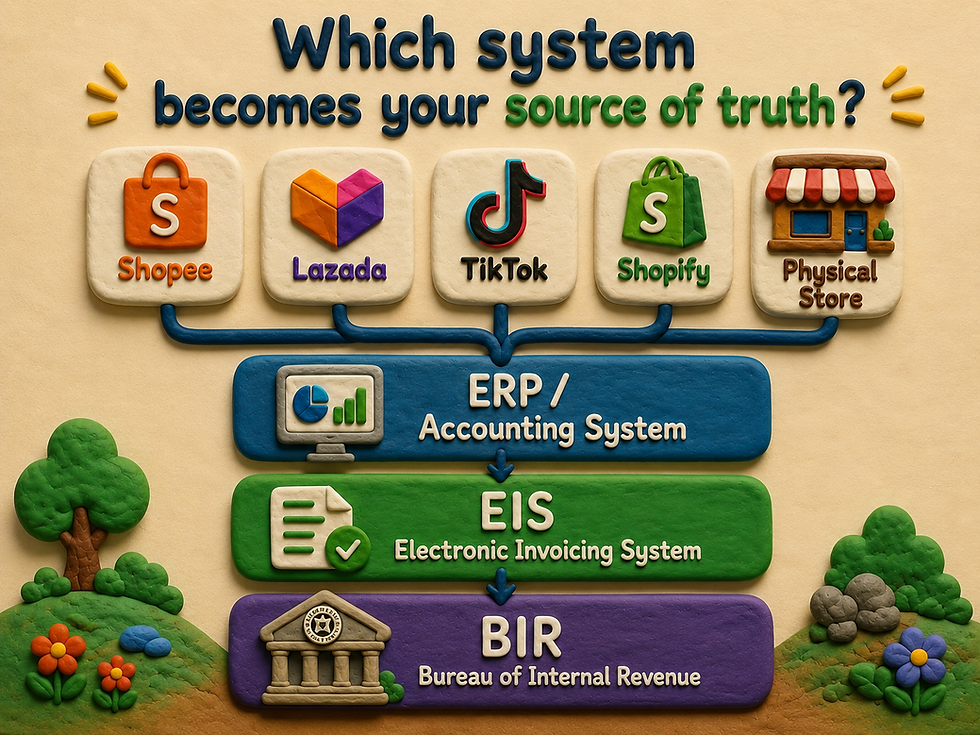
EIS (Electronic Invoicing System): The BIR's online platform that receives, processes, and stores sales data from businesses.
CAS (Computerized Accounting System): Your accounting or invoicing software. QuickBooks, Xero, Odoo, SAP, NetSuite, AutoCount, a custom ERP — anything that produces invoices and books.
Micro taxpayer: A business with gross annual sales below ₱3 million. Generally exempt from the new rule (we'll cover the catch).
The big mental shift:
A PDF is what your customer reads.
Structured data is what the BIR system reads.
The rule cares most about the data.
The biggest myth: "I'll just upload a PDF"
This is the #1 misconception in the market. Burn it out of your brain now.
Uploading a PDF to Shopee is not the same as BIR compliance.
The rule literally says a photo or scanned copy of a paper invoice is not an electronic invoice. It goes further: even invoices made by software don't count if they can't report the data electronically.
So these are not automatically compliant:
Scanned invoices
Photos of invoices
PDFs you made by hand
Excel invoices saved as PDF
POS receipts saved as PDF
A digital document is not enough. The invoice has to exist as structured data.
Say it out loud: "This is not a PDF problem. It's a data problem." That sentence will save you a lot of money later.
Ecample: Shopee's requirement vs the BIR's requirement
Another thing people blend together. They're related, not identical.
What Shopee (or Lazada/TikTok) wants: Upload an invoice file to each completed order. A platform housekeeping rule.
What the BIR wants: Structured invoice data, generated by registered software, reportable to the BIR.
You can satisfy Shopee and still not satisfy the BIR.
The marketplaces are also clear that they do not issue invoices for you. That's your job as the seller.
OK — does this even apply to me?
Run through this checklist. If any one line is true, assume you're covered:
You sell on Shopee, Lazada, TikTok Shop, Shopify, WooCommerce, or your own site
You're registered under the BIR's Large Taxpayers Service
You use accounting or invoicing software (CAS) or computerized books (CBA)
You're a VAT-registered seller
Your total annual sales are ₱3 million or more (both online and offline!)
The rule defines "e-commerce" very broadly: online goods, digital goods, services, content creators, subscriptions, freelancers, marketplaces. If you make money online, treat this as relevant.
Wait — aren't small sellers exempt?
Partly. And there's a trap.
The exemption: Micro taxpayers (under ₱3M gross annual sales) are generally exempt from the mandatory e-invoice requirement, thanks to the Ease of Paying Taxes Act.
Trap #1 — it's your TOTAL sales, not just online. The ₱3M is your whole business across all channels. Online + offline + B2B + distributors. Your Shopee store might do ₱2M, but if everything together is ₱5M, you're likely covered.
Trap #2 — "small today" doesn't mean small in 2026. A business doing ₱2.8M now can cross ₱3M before the deadline. If you're close, prepare anyway.
Trap #3 — exempt isn't excused from everything. Existing invoice rules still apply. And future BIR rules may widen coverage.
If you're truly micro and want to stay simple: you can still issue manual invoices for now. Just keep an eye on your total sales and future BIR notices.
When is the deadline?
Here's where the good news lives.
The original deadline was March 2026. It was pushed back.
A later rule, RR No. 26-2025, extended it. Covered taxpayers now have until December 31, 2026 to comply with the e-invoice issuance requirement.
And the reporting side (Thing 2)? That only switches on once the BIR's own system is ready to receive the data. As of 2026, that part is still being built. Separate rules will follow.
So, in plain terms:
By Dec 31, 2026: be able to issue structured e-invoices from registered software.
Later (no firm date yet): full automatic reporting to the BIR.
Do not read "extended" as "ignore it." For bigger businesses, getting systems ready can take many months. Starting late is how people end up paying for rush jobs.
The 30-second summary
The BIR wants invoices as structured data, not paper or plain PDFs.
There are two requirements: issuing e-invoices, and reporting sales data.
Issuing structured e-invoices is due December 31, 2026.
Reporting starts when the BIR's system is ready (later).
If you sell online, use accounting software, are VAT-registered, or do ₱3M+ total sales — you're likely covered.
Micro businesses (under ₱3M total) are mostly exempt, but watch the traps.
Uploading a PDF to Shopee ≠ being compliant with the BIR.
FAQs
Is this a real law or just a Shopee thing? Real BIR rule. RR No. 11-2025, extended by RR No. 26-2025. Shopee is just reacting to it. The duty is yours, not the platform's.
My online sales are under ₱3M. Am I safe? Maybe — but the ₱3M is your total sales across all channels, not just online. Add everything up before deciding. If unsure, ask your accountant.
Is a PDF invoice enough? No. A PDF on its own is a document, not structured data. The BIR wants the data. A PDF can be the human-readable copy on top of the data, but not instead of it.
Will Shopee/Lazada handle compliance for me? No. They may give you tools to upload invoices, but the responsibility stays with you. They've said plainly they don't issue invoices on your behalf.
What's the difference between issuing and reporting again? Issuing = creating the e-invoice. Reporting = sending that data to the BIR. Issuing is due Dec 31, 2026. Reporting kicks in once the BIR's system is live.
Do I need to do anything right now if I'm covered? Yes — start understanding your current invoice process. You don't need to buy anything today. You do need to know how invoices flow through your business. Part 3 walks through this.
I do both online and physical store sales. Does the rule treat them separately? Look at your business as a whole, not channel by channel. If you're covered, your invoicing will eventually need to account for all sales, online and offline.
This guide explains the rules in plain language. It is not legal or tax advice. For your specific situation, confirm with your accountant or tax adviser, and check the BIR's official issuances (RR No. 11-2025 and RR No. 26-2025).
Next up — Part 2: What's actually at stake if you ignore this, and why high-volume sellers are the most exposed.
Intimidated? Overwhelmed? Your accountant knows the rules. We know the operations. Agyle Brands isn't an accounting firm — we're the team that helps ecommerce brands turn "we have eight systems that don't talk" into one clean, compliant flow. We work hand-in-hand with your finance and accounting people, not around them. Don't wait for the deadline to find the gaps. Reach out for a consultation — and let's make sure compliance isn't what trips you up when you're ramping up.


Comments