
The eCommerce BIR E-Invoicing Survival Guide: If You Do 500 Orders a Day, You're the Most Exposed. Why high-volume sellers can't afford to wait on e-invoicing.

The BIR E-Invoicing Rule, Explained Simply
Part 2 of 3: What's at Stake (and Why Waiting Is the Real Risk)
In Part 1, we covered what the rule is and whether it applies to you.
Now the uncomfortable part: what happens if you don't get ready?
Short version: there are fines. But the fines aren't even the scariest part. The scariest part is what this does to a busy business that waits too long.
Let's break it down.
First, the honest context
Right now, the BIR has signaled it's focused on educating and guiding businesses, not hunting them down with penalties.
That's reassuring. It is also temporary.
Here's the thing about "education mode": it ends. Usually right around the deadline. And the penalties on the books are real and already written into law.
So treat the soft posture as breathing room to prepare, not permission to ignore.
The penalties (in plain numbers)
Your source documents had two different penalty figures floating around. Both are correct. They just punish two different mistakes.
Mistake 1 — Not issuing a proper invoice (Tax Code, Section 264)
Fine: ₱1,000 to ₱50,000 for each offense
Plus possible imprisonment: 2 to 4 years
Applies per act — so many bad invoices means many offenses
Mistake 2 — Not transmitting your sales data (Tax Code, Section 264-A)
Penalty: ₱10,000 per day — or 1/10 of 1% of your annual net income, whichever is higher
Yes, per day of failure
And if you rack up more than 180 days of violations in one year: permanent closure
Read that again. The transmission penalty is a daily meter, not a one-time slap. For a business of any size, "per day" adds up frighteningly fast.
A quick note for calm: the daily transmission penalty (Mistake 2) is tied to the reporting requirement, which only fully switches on once the BIR's system is ready. The issuance penalty (Mistake 1) is the one tied to the December 31, 2026 deadline. But both are coming. Plan for both.
Now the bigger danger: the operational trap
Forget the fines for a second.
The real risk is this: e-invoicing is not an accounting task. It's a systems task.
If you treat it like a last-minute accounting chore, you will hit a wall. Because making it work means your sales channels, warehouse, accounting, and invoicing all have to talk to each other cleanly.
Most businesses discover — usually too late — that their systems don't talk to each other.
That's not a problem you fix in a weekend.
Why 500-orders-a-day sellers are the most exposed
If you're doing high volume across multiple channels, this section is for you. You are in the highest-risk group. Here's why.
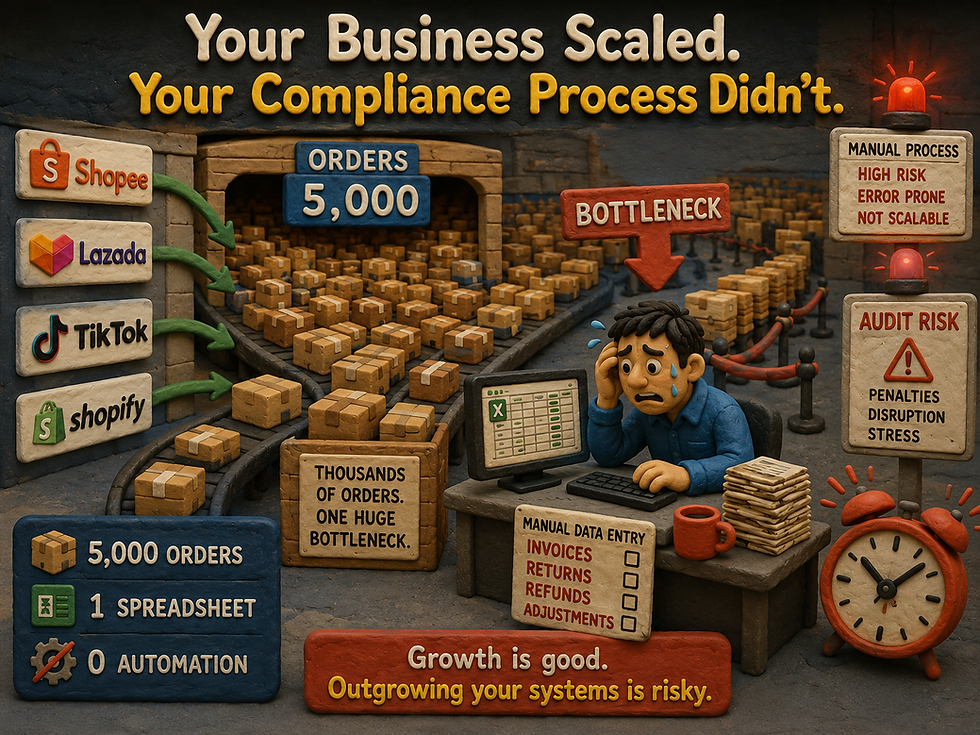
1. Manual entry is physically impossible at your scale.
Picture typing every invoice into a government portal by hand:
20 orders/day → annoying
100 orders/day → a full-time job
500 orders/day → not happening
5,000 orders/day → comedy
At your volume, manual compliance isn't a backup plan. It's a non-starter. You need systems that generate and report invoices automatically. And systems take time to set up.
2. You probably sell in many places at once.
A typical high-volume brand runs some mix of:
Shopee
Lazada
TikTok Shop
Shopify / own website
Physical store / POS
B2B and distributor sales
A warehouse system
Accounting software
Each one creates sales records. The BIR doesn't want eight separate stories. It wants one accurate, complete picture of your business.
3. Your hardest question isn't "how do I make an invoice."
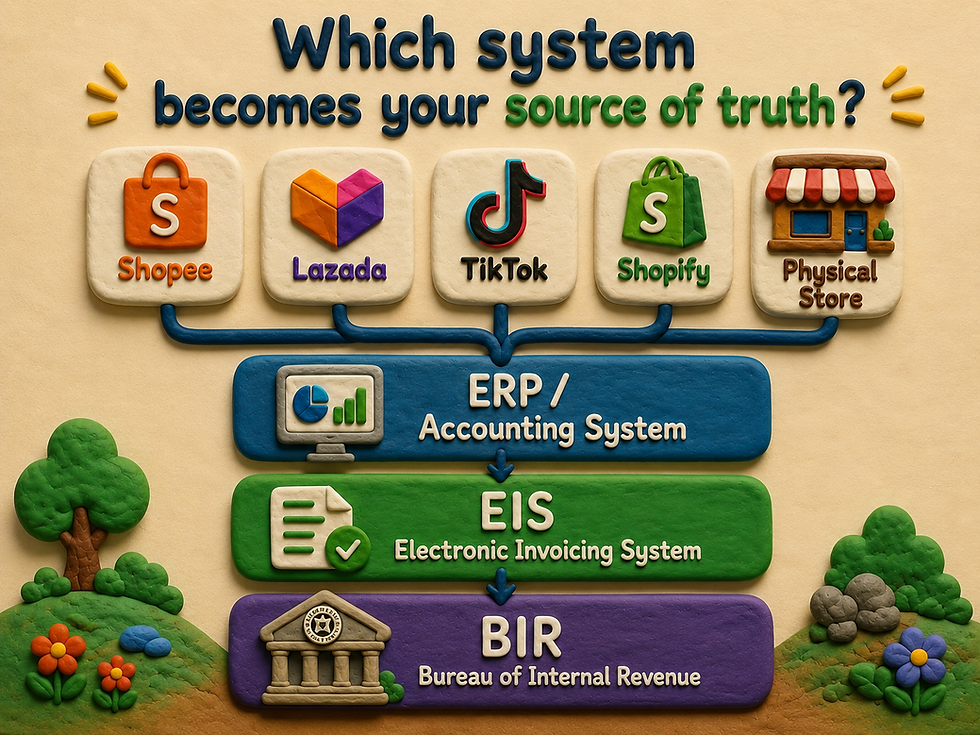
It's: "Which of my systems is the single source of truth?"
Source of truth (plain English): the one system that holds the real, complete, final record of every sale — across all channels — that everything else must match.
If Shopee says one thing, your accounting says another, and your warehouse says a third, you have a reconciliation nightmare. The rule will expose every gap between your systems.
4. Offline sales make it harder, not easier.
Selling online and in a physical store means two different worlds (marketplace data + POS data) that now have to roll up into one compliant report. More systems, more seams, more places to break.
The "it's really about data" insight
This is the single most important idea in the whole topic. Most articles miss it.
The BIR is not asking, "Can you produce a document?"
It's asking, "Can your sales data flow — accurately and automatically — from where the sale happens to where the BIR can see it?"
That means the question every founder should be asking is not:
"How do I generate a PDF invoice?"
It's:
"How does my sales data move from Shopee, Lazada, TikTok, Shopify, my POS, and my accounting software into one compliant system?"
If you can answer that clearly, you're ahead of 95% of businesses.
The cost of waiting (a reality check)
"December 2026 is far away." It isn't. Here's why.
System projects run long. Picking software, connecting channels, cleaning data, testing — months, not days. For big operations, sometimes a year+.
Your data is probably messy. Duplicate customers, wrong product info, mismatched records. You'll need time to clean it before anything reports cleanly.
Vendors get slammed near deadlines. Everyone scrambles at once. Prices rise. Good help gets booked. Implementation slots fill.
Rushed setups break. Last-minute integrations are the ones that fail in production — usually on a high-sales day.
Waiting doesn't save effort. It just moves the effort to the worst possible moment and adds a premium.
The upside nobody mentions
This isn't all pain. Two real wins:
1. The government will help pay for it.
Under the CREATE MORE Act, you can claim an extra tax deduction for the cost of setting up your electronic sales reporting system:
Micro and Small taxpayers: up to 100% of the cost
Medium and Large taxpayers: up to 50% of the cost
(Claimable once, in the year the system is finished or fully paid. The imported system itself may also be tax-exempt.)
That meaningfully lowers the real price of getting compliant. Budget for it, then claim it.
2. You come out of this a better-run business.
Businesses that integrate their systems properly get things they always wanted anyway:
One clean view of all sales
Faster, more accurate books
Fewer manual errors
Better reconciliation across channels
Audit trails that actually hold up
The brands that prepare early don't just avoid penalties. They run tighter than competitors who scrambled.
The 30-second summary
Penalties are real: up to ₱50,000 per bad invoice, and up to ₱10,000+ per day for failure to report.
Over 180 days of reporting violations can mean permanent closure.
The BIR is in "education mode" now — that's prep time, not a free pass.
The deeper risk is operational: your systems must connect, and that takes months.
High-volume, multi-channel sellers are most exposed — manual compliance is impossible at scale.
The real question is about data flow and a single source of truth, not PDFs.
Waiting raises cost and risk. Starting early lowers both — and you can deduct much of the cost.
FAQs
If the BIR isn't strictly enforcing yet, why rush? Because the work takes months, not days — and "education mode" ends near the deadline. You're not racing the penalty. You're racing the calendar on a systems project.
₱50,000 or ₱10,000 per day — which one hits me? Different mistakes. ₱50,000 (max) is for failing to issue a proper invoice. ₱10,000+ per day is for failing to transmit sales data. You want to avoid both.
Can the BIR really shut my business down? The law allows permanent closure if reporting violations exceed 180 days in a taxable year. It's a serious provision. Don't get anywhere near it.
I only sell on one platform. Am I less exposed? Somewhat — a single-channel, lower-volume seller has a simpler path. But "simpler" still isn't "nothing." You still need a compliant way to issue invoices.
Is this really not just an accounting problem? Correct. For anyone past a few dozen orders a day, it's a systems-and-data problem. Accounting is one piece. Your sales channels, warehouse, and integrations are the rest.
What's the single biggest mistake businesses are making? Assuming "make a PDF and upload it" equals compliance. It doesn't. That assumption is what causes the painful, expensive scramble later.
How much will compliance cost? It varies widely by size and setup. But remember the CREATE MORE deduction can cover 50–100% of the system cost. Get a real quote, then factor in the deduction.
This guide explains the rules in plain language. It is not legal or tax advice. For your specific situation, confirm with your accountant or tax adviser, and check the BIR's official issuances (RR No. 11-2025 and RR No. 26-2025).
Next up — Part 3: Your options for complying, and a step-by-step plan to get there without losing your mind. Missed Part 1, click here.
Intimidated? Overwhelmed? Your accountant knows the rules. We know the operations. Agyle Brands isn't an accounting firm — we're the team that helps ecommerce brands turn "we have eight systems that don't talk" into one clean, compliant flow. We work hand-in-hand with your finance and accounting people, not around them. Don't wait for the deadline to find the gaps. Reach out for a consultation — and let's make sure compliance isn't what trips you up when you're ramping up.



Comments