
The eCommerce BIR E-Invoicing Survival Guide: 3 Ways to Survive BIR E-Invoicing (Pick Yours) From "type it by hand" to "fully automated."

The BIR E-Invoicing Rule, Explained Simply
Part 3 of 3: How to Comply (Your Options, Step by Step)
You know what the rule is (Part 1). You know what's at stake (Part 2).
Now the part you actually came for: what do I do?
Good news — you have options. Better news — there's a clear order to follow. Let's go.
Before anything: know where you stand
Don't buy software yet. Don't panic-call a vendor yet. First, answer two questions honestly.
Question 1: Am I covered? Quick re-check from Part 1 — you're likely covered if any of these is true:
You sell online (Shopee, Lazada, TikTok, Shopify, own site)
You use accounting/invoicing software
You're VAT-registered
Your total annual sales are ₱3M+
You're a Large Taxpayer
Question 2: How big and how messy am I? Two things decide how hard your path is:
Volume — orders per day
Channels — how many places you sell (online + offline + B2B)
More volume + more channels = more work. That's the whole formula.
Step 1: Map how invoices flow today
This is the step everyone skips. Don't.
Grab a pen. Write down, for your business:
Where orders come from (which platforms, store, B2B)
How invoices get created today
Where the accounting entry happens
How inventory and the warehouse track it
How returns and refunds get handled
Who controls invoice numbers
Most businesses get a shock here. They realize they have several disconnected systems that don't agree with each other.
That picture is your compliance project. You can't fix what you haven't mapped.
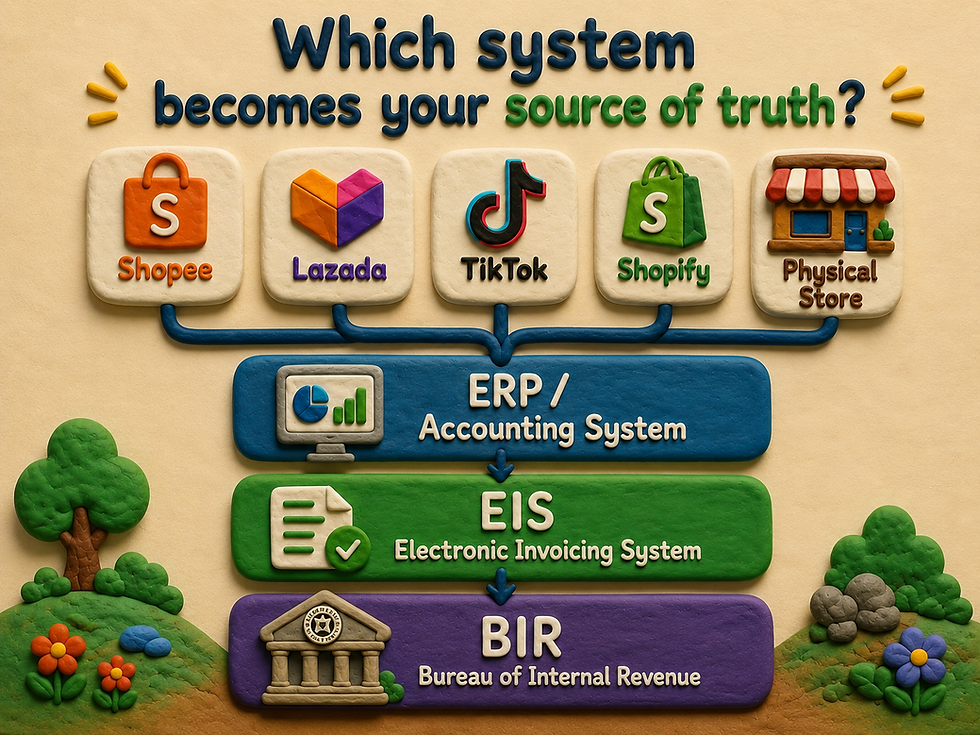
Step 2: Find your "source of truth"
Source of truth (plain English): the one system that holds the real, complete, final record of every sale across all channels. Everything else must match it.
Ask yourself: if Shopee, Lazada, my POS, and my accounting software all disagree about a sale — which one is right?
That system is where your e-invoicing should ultimately come from.
Single channel? Your one platform or your accounting software can be the source.
Multi-channel? It almost always needs to be your accounting system or ERP — the layer where all sales come together.
ERP (plain English): software that runs the core of your business (sales, inventory, accounting, operations) in one connected system. Think of it as the central brain.
This is the key decision for high-volume sellers. Get it right and everything downstream gets easier.
Step 3: Pick your path (there are three)
Here are your realistic options, from simplest to most powerful. Pick based on your volume and channels.
Path A — Manual entry through the BIR portal
How it works: Log in to the BIR's EIS portal → type in invoice details → generate the e-invoice → download it → upload to your platform.
Good for:
Very small sellers
A handful of orders per day
One channel
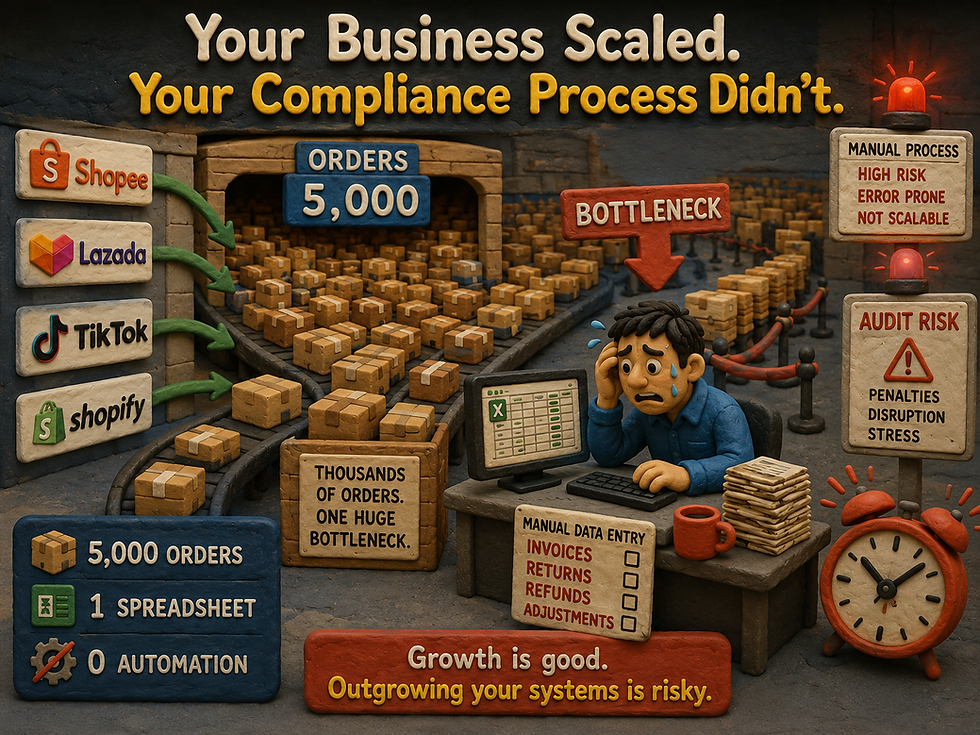
Reality check: Fine for 5–10 orders a day. Miserable at 50. Impossible at 500. If you're growing, don't build your life around this.
Path B — BIR-registered invoicing / accounting software
How it works: Your software (CAS) creates compliant structured e-invoices for you. Less typing, fewer errors.
Good for:
Growing sellers
Medium volume
A few channels
What to check: Make sure the software is BIR-registered/accredited for e-invoicing — not just "digital." Many tools make PDFs and call it e-invoicing. That's not the same thing. (Ask the vendor directly; see the questions below.)
Path C — Full system integration (automated)
How it works: Your channels feed one central system, which generates invoices and reports them automatically. No manual typing. The flow looks like this:
Customer orders on Shopee / Lazada / TikTok / Shopify / store
↓
Order lands in your ERP / OMS / accounting system
↓
Invoice generated automatically as structured data
↓
Sent electronically to the BIR (when the BIR system is live)
↓
Human-readable PDF created for the customer
↓
Uploaded back to the marketplace automatically
OMS (plain English): Order Management System — software that pulls orders from all your sales channels into one place.
Middleware (plain English): connector software that lets two systems that don't naturally talk to each other exchange data. The translator between your shop and the BIR.
Good for:
High-volume sellers (hundreds to thousands of orders/day)
Multi-channel businesses
Anyone selling online and offline
Reality check: This is where most serious ecommerce brands will land. It's the biggest project — but it's the only thing that survives real volume.
Which path is yours? (quick guide)
Your situation | Likely path |
Under ₱3M total sales, tiny volume | Possibly exempt — Path A if you opt in |
Low volume, one channel | Path A or B |
Growing, a few channels | Path B |
500+ orders/day, multi-channel, online + offline | Path C |
If you're the bottom row — that's the primary audience for this guide — assume Path C and start planning now. Integration is not a deadline-week task.
Step 4: A simple roadmap (do this in order)
You don't have to do everything at once. Follow the sequence:
Confirm coverage. Are you in scope? (Step 0 above.)
Map your invoice flow. Every system that touches a sale. (Step 1.)
Pick your source of truth. Usually your ERP/accounting layer. (Step 2.)
List every channel that creates sales data. Online, offline, B2B, everything.
Check each system: can it produce structured invoice data? Ask the vendor.
Choose your path (A, B, or C) based on volume and channels.
Talk to your accountant about coverage, classification, and the deduction.
Talk to software vendors with the right questions (below).
Clean your data. Customers, products, TINs, tax settings.
Test before you rely on it. Especially the channel-to-BIR connection.
The earlier you start, the more of this you do calmly instead of in a panic.
Step 5: Ask vendors the right questions
Software sales pitches love the word "e-invoicing." Make them prove it. Ask:
Is your system BIR-registered/accredited for e-invoicing?
Can it generate structured invoice data (JSON/XML), not just PDFs?
Can it transmit to the BIR's EIS when the reporting system goes live?
Does it connect to Shopee, Lazada, TikTok, Shopify and my POS?
Can it handle returns, refunds, and cancellations as proper adjustments?
Can it consolidate all my channels into one report?
What happens to my data during a BIR audit — can I retrieve it fast?
If a vendor dodges the first two questions, walk away.
Step 6: Ask your accountant the right questions
Many accountants know invoice issuance rules well but are still catching up on electronic reporting. Ask directly:
Based on my total sales, am I covered or exempt?
What's my taxpayer classification (micro / small / medium / large)?
How do I claim the CREATE MORE deduction for my system cost?
Do my offline and B2B sales change anything?
What records must I keep, and for how long?
Don't leave money on the table
Reminder from Part 2 — the CREATE MORE Act gives you an extra deduction on the cost of your e-invoicing/reporting system:
Micro & Small: up to 100% of the cost
Medium & Large: up to 50% of the cost
Claimable once, in the year you finish or fully pay for the system. Build this into your budget and your accountant's plan from day one.
A note for the multi-channel, high-volume crowd
If you're running 500+ orders a day across marketplaces and a physical presence, your real project isn't "buy an e-invoicing tool." It's:
Consolidate all channels into one source of truth (ERP/OMS).
Connect that source to the BIR's system (via accredited software or middleware).
Reconcile automatically — including returns and refunds.
Do that, and compliance becomes a byproduct of finally having one clean view of your business. That's the win hiding inside the headache.
The 30-second summary
Don't buy first. Map first. Know how invoices flow today.
Pick your source of truth — for multi-channel, that's usually your ERP/accounting layer.
Three paths: manual portal (tiny sellers), registered software (growing), full integration (high volume).
500+ orders/day, multi-channel → plan for full integration now.
Vet vendors hard — "structured data" and "BIR-accredited," or walk away.
Use the CREATE MORE deduction to cover 50–100% of the cost.
Start early. This is a months-long systems project, not a deadline-week errand.
FAQs
Do I need to replace my accounting software? Not always. Some systems can be upgraded or connected with middleware. Others can't produce structured data and will need replacing. That's exactly what Step 5 (vendor questions) is for.
Do I need both CAS and EIS? No, you don't strictly need CAS to use the BIR's EIS. Tiny sellers can enter invoices manually in the EIS portal. But at any real volume, CAS/ERP + integration is the practical answer — manual entry doesn't scale.
Will Shopee or Lazada just do this for me? No. They may help you upload invoices, but they can't see your full business (offline sales, B2B, other channels). The BIR wants taxpayer-level reporting. That has to come from your own consolidated system.
Do I need API integration? Not if you're tiny. Yes, effectively, if you're high-volume or multi-channel. The more orders you process, the more you'll need automation rather than manual encoding.
API (plain English): a way for two software systems to send data to each other automatically, without a human copying it over.
What if I use several systems that don't talk to each other? Very common. The fix is choosing a source of truth and connecting the others to it (directly or via middleware). The challenge usually isn't making invoices — it's keeping data consistent across systems.
Are B2B and B2C both affected? Expect both to be covered, though the invoice details may differ by transaction type. Review the specific rules for your customer mix with your accountant.
Do I still issue official receipts/invoices the old way until 2026? Keep following current BIR invoicing rules while you prepare. E-invoicing changes how invoice data is generated and reported — it doesn't cancel your existing obligations.
How long do I keep electronic invoices? They're tax records, subject to retention rules under Philippine tax law. Keep proper backups and confirm the exact retention period with current BIR rules.
Where do I start if I only do one thing this month? Map your invoice flow (Step 1). It costs nothing, needs no software, and tells you exactly how big your project really is.
This guide explains the rules in plain language. It is not legal or tax advice. For your specific situation, confirm with your accountant or tax adviser, and check the BIR's official issuances (RR No. 11-2025 and RR No. 26-2025) and the BIR EIS portal.sour
That's the series, click here for Part 1, and Part 2 . Understand it, weigh the stakes, then work the plan — in that order.
Intimidated? Overwhelmed? Your accountant knows the rules. We know the operations. Agyle Brands isn't an accounting firm — we're the team that helps ecommerce brands turn "we have eight systems that don't talk" into one clean, compliant flow. We work hand-in-hand with your finance and accounting people, not around them. Don't wait for the deadline to find the gaps. Reach out for a consultation — and let's make sure compliance isn't what trips you up when you're ramping up.



Comments